
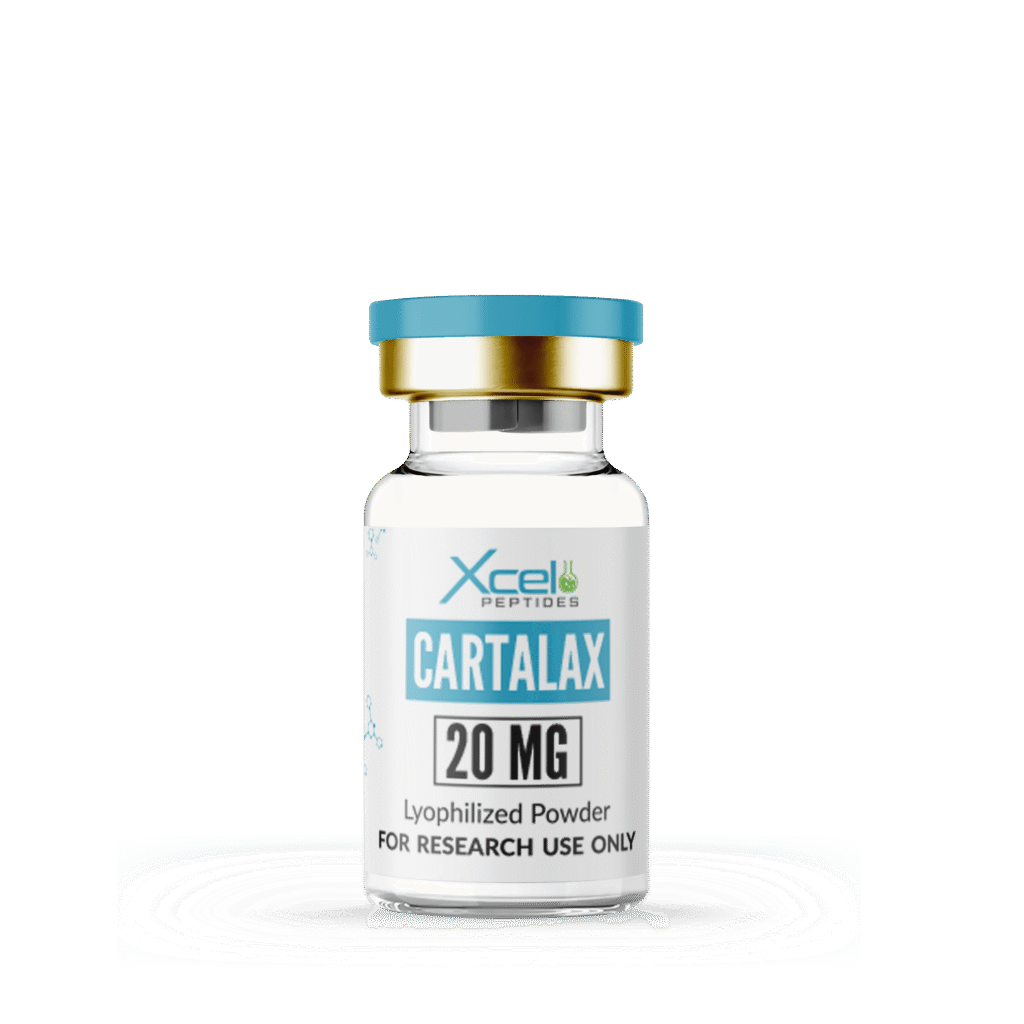
Quick answer: Cartalax is a synthetic tripeptide made of three amino acids: alanine, glutamic acid, and aspartic acid (Ala-Glu-Asp, or AED). Researchers developed it within the Khavinson family of short-peptide bioregulators and study it in cell models of gene expression and aging. It is a research compound, not an approved medicine.
This guide explains what Cartalax peptides are, what the published research covers, and where the evidence stops. It also shows you how to judge the quality of any batch before you use it in a study.
Cartalax Peptides at a Glance
Here are the key facts in one place.
- Name: Cartalax, also written as AED or T-31
- Sequence: Ala-Glu-Asp (alanine, glutamic acid, aspartic acid)
- Type: Synthetic tripeptide, three amino acids long
- Approximate molecular weight: 333.3 g/mol (calculated)
- PubChem CID: 87815447
- Family: Khavinson short-peptide bioregulators
- Origin: Developed in Russia at the St. Petersburg Institute of Bioregulation and Gerontology
- Status: Research compound, not FDA approved
What Is Cartalax?
Cartalax is a short synthetic peptide. It contains just three amino acids joined in the order Ala-Glu-Asp. Vladimir Khavinson and colleagues designed it as part of a group of very short peptides, each matched to a particular tissue. Cartalax is the member of the group linked to cartilage-related research.
The name can be confusing, because suppliers use “Cartalax” for different things. Some sell the pure AED tripeptide as a lyophilized powder. Others sell capsules containing a broader cartilage-derived peptide mixture. These are not the same product, so always check the sequence on the label.
What Is the Cartalax Peptide Sequence?
The sequence is Ala-Glu-Asp, often shortened to AED. That means alanine at one end, glutamic acid in the middle, and aspartic acid at the other end. A genuine batch should match this sequence and the calculated mass of about 333.3 g/mol on its mass spectrometry report.
What Is a Bioregulator Peptide?
A bioregulator peptide is a short chain of two to four amino acids. Khavinson’s group designed these peptides to match small fractions found in specific tissues. Related examples include Vilon (Lys-Glu), Vesugen (Lys-Glu-Asp), Pinealon (Glu-Asp-Arg), and Livagen (Lys-Glu-Asp-Ala).
The central idea is that very short peptides can enter cells and interact with DNA or chromatin. Researchers call this a proposed mechanism. It remains an active area of study and not a settled one.
How Is Cartalax Thought to Work?
The Khavinson model proposes that short peptides bind to DNA or to histone proteins and change which genes cells switch on. A peer-reviewed study of the related peptide Epitalon reported that several short bioregulators bound histone proteins in laboratory tests. That work supports the general mechanism for the class, but it does not prove how Cartalax itself acts.
Treat the mechanism as a hypothesis. Researchers still debate how such small peptides reach the nucleus and how selective they are.
What Does Research on Cartalax Show?
Published work on Cartalax is mostly laboratory research. Studies cited in the scientific literature include experiments on kidney tissue cultures from young and old animals, work on skin fibroblasts during aging in vitro, and a review titled “Short Peptides Regulate Gene Expression.” A 2020 paper also examined gene expression in aging human mesenchymal stem cell cultures and how short peptides modulated it.
Taken together, these studies examine gene expression, cell renewal, and cellular aging in cultured cells. You can read the full reference list on the Cartalax entry on Wikipedia.
What Are the Limits of the Evidence?
This section matters, because it tells you how much weight to give the research.
First, most published studies come from the group that developed the peptide. Independent replication is limited. Second, the work relies on cell cultures and animal models, so it does not show what happens in people. Third, the proposed mechanism is still under debate.
No regulator has approved Cartalax for any use. Anyone claiming it treats a joint or cartilage condition is going beyond the evidence.
How Is Cartalax Different From Vesugen, Epitalon, and BPC-157?
The differences come down to sequence and research focus.
Cartalax (AED) is a tripeptide linked to cartilage-related research. Vesugen (KED) is a tripeptide linked to vascular research. Epitalon (AEDG) is a tetrapeptide linked to pineal research. BPC-157 is a different kind of peptide altogether, with 15 amino acids and a different research background.
The similar letters in these names make mix-ups common. Check the full sequence on every product page and COA.
Is Cartalax FDA Approved or Legal?
No. Cartalax is not an approved drug in the US, UK, or EU. Suppliers sell it for laboratory research only, and it is not intended for human or animal use.
Rules differ by country, and in the US they can differ by state. Researchers in the UK and Europe should also expect customs checks on shipments. We are not lawyers, so check your local requirements before you order.
How Do You Check the Quality of Cartalax Peptides?
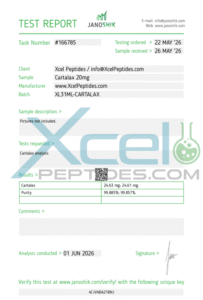
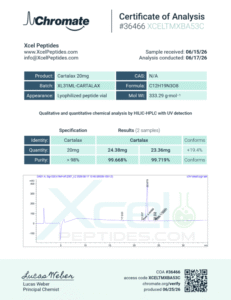
A certificate of analysis (COA) is your best tool. Run through four checks on every batch.
First, match the batch number on the COA to the number on your vial. Second, look at the HPLC chromatogram, where one dominant peak signals good purity. Third, confirm the mass spectrometry result matches the AED mass of about 333.3 g/mol. Fourth, check that the test date is recent.
A COA that fails any of these checks is a reason to ask questions before you use the material. You can browse results on our COA page.
How Should Cartalax Peptides Be Stored?
Store the lyophilized powder frozen, sealed, and protected from light. After reconstitution, refrigerate the solution and use it within a short window. Avoid repeated freeze-thaw cycles, because each cycle degrades the peptide further. Record the batch number and opening date in your lab notes.
Frequently Asked Questions About Cartalax Peptides
What are Cartalax peptides? Cartalax is a synthetic tripeptide with the sequence Ala-Glu-Asp (AED). Researchers study it in cell models of gene expression and cellular aging.
Is Cartalax a peptide or a supplement? In research settings, it is a synthetic peptide. Some regions sell products under the same name as food supplements, and those are different, often mixed-peptide products.
What does AED stand for? AED stands for the three amino acids in the sequence: alanine (A), glutamic acid (E), and aspartic acid (D).
Is Cartalax the same as Epitalon? No. Cartalax is the tripeptide AED, while Epitalon is the tetrapeptide AEDG. They share three amino acids but are different compounds.
Is Cartalax approved by the FDA? No. It is a research compound, and no regulator has approved it for any use.
How do I verify a Cartalax batch? Match the batch number, check the HPLC peak, confirm the mass spectrometry result, and check the test date on the COA.
Where can I buy Cartalax for research? Xcel Peptides supplies Cartalax (Bioregulator) for laboratory use, with a batch-matched COA on every product page.
Need Help With an Order or a COA?
If you have a question about a batch, a COA, or shipping to your region, we would rather answer it than have you guess. Our team replies within one business day.
Email us at info.xcelpeptide@gmail.com, use the contact form, or browse the Bioregulators category to see the full range. When you are ready, place your order with a supplier that shows its testing data.
Disclaimer: Xcel Peptides supplies Cartalax and related compounds for laboratory and research use only. They are not drugs, dietary supplements, or food, and are not intended for human or animal consumption, or for diagnostic or therapeutic use. This article is informational and does not constitute medical or legal advice.

Products by Category
-
Testagen (Bioregulator)
$35.99 -
Vesugen (Bioregulator)
$34.99 -
Vilon (Bioregulator)
$34.99
